
Most people searching for the best hospitals in Dubai are not ill. They are moving here, or thinking about it, and they want to know what happens if something goes wrong.
That is a property question as much as a medical one. A hospital you can reach in twelve minutes is a different proposition from one you can reach in forty, and the difference is decided when you choose a community, not when you need the ambulance.
So this guide does two things. It sets out which hospitals in Dubai hold the credentials that actually mean something, and it maps the major ones against the communities people buy and rent in. We publish no ranking. There is no official list of the best hospitals in Dubai, and any article that gives you one has made it up.
What the credentials actually mean
Two things are worth checking before anything else, and neither is a magazine ranking.
A DHA licence is the floor, not a distinction. Every hospital, clinic and practitioner operating in Dubai must be licensed by the Dubai Health Authority, and you can verify any individual doctor’s licence yourself through the authority’s Sheryan system. A facility advertising that it is DHA licensed is telling you it is legally allowed to open its doors. That is all.
JCI accreditation is the one that separates. The Joint Commission International assesses hospitals against the same patient-safety standards used in the United States, and re-assesses every three years. A hospital that holds it has been audited by outsiders on infection control, medication handling, surgical protocol and record-keeping. A hospital that does not hold it is not necessarily worse, but nobody independent has checked.
American Hospital Dubai became the first hospital in the Middle East to receive JCI accreditation, in May 2000, and has renewed it seven times since. Most of Dubai’s established private hospital groups have followed.
What neither credential tells you is whether a particular surgeon is good, whether the emergency department is staffed at 3am, or whether your insurance is accepted there. Those are the questions worth asking once the shortlist is down to three.
The major private hospitals, and where they are
These are the Dubai hospitals whose international accreditation we were able to verify on the accrediting body’s or the hospital’s own published record. It is not every hospital in the city. Dubai has well over forty, and the absence of a name below is not a judgement on it.
| Hospital | Area | Known for | Accreditation |
|---|---|---|---|
| American Hospital Dubai | Oud Metha | American-standard tertiary care, oncology, cardiology; branches in Al Barsha, Jumeirah, Media City, Dubai Hills, Mira, Al Khawaneej, Nad Al Sheba | JCI since May 2000, renewed seven times; CAP-accredited laboratory |
| Mediclinic City Hospital | Dubai Healthcare City | 280 beds; comprehensive cancer centre, heart and vascular centre, stroke unit, robotic surgery, neonatal care | JCI |
| King’s College Hospital London | Dubai Hills | 24/7 emergency, liver transplant, cardiothoracic surgery, paediatric NICU; British-trained consultants | JCI; SRC Centre of Excellence in five specialties |
| Medcare Hospital Al Safa | Al Safa | General multi-specialty, 40-plus specialties | JCI |
| Medcare Women & Children Hospital | Al Safa | Obstetrics, gynaecology, paediatrics | JCI |
| Medcare Orthopaedics and Spine Hospital | Al Safa | Orthopaedics, spine, sports injury | JCI |
| Fakeeh University Hospital | Dubai Silicon Oasis | Tertiary care, academic hospital | JCI |
Saudi German Hospital in Al Barsha 3, Al Zahra Hospital in Al Barsha, Aster Hospital in Mankhool, Canadian Specialist Hospital in Deira, Prime Hospital in Garhoud and Zulekha Hospital in Al Qusais are all substantial general hospitals serving large catchments. We have not independently verified their current accreditation status for this guide, and you should check it directly if it matters to your decision.
On the public side, Dubai Health runs Rashid Hospital, Dubai Hospital, Latifa Hospital for women and children, and Hatta Hospital. Emergency care at a public hospital is available to anyone, resident or not.
Public, private, and what your insurance actually buys
Health insurance is mandatory in Dubai. It has been since the emirate’s 2014 framework, and the rule is enforced: an employer who leaves a staff member uninsured faces a fine of AED 500 to AED 1,000 per month per person.
The structure matters more than the mandate. Your employer covers you. You cover everyone else, spouse, children, parents on your sponsorship, domestic staff. A family of four on a single sponsor is four policies, and only one of them is somebody else’s obligation.
At the bottom of the market sits the Essential Benefits Plan, the minimum legal cover for anyone earning AED 4,000 a month or less including housing. It is real insurance, but it is thin: 20% co-pay on inpatient care capped at AED 500, 25% on outpatient capped at AED 100 per visit, 30% on pharmacy capped at AED 1,500 a year. An EBP card does not open the door at American Hospital or King’s College.
This is the part people discover late. The hospital nearest your new home may not be in your network, and the network is set by your policy tier, not your postcode. Before you commit to a community on the strength of a hospital five minutes away, confirm that your plan is accepted there and at what co-pay. The hospital’s billing desk will tell you over the phone in under five minutes.
Hospitals mapped to where people buy
The useful question is not which hospital is best. It is which hospital you would actually end up at, and how long it takes to get there at eight on a weekday morning.
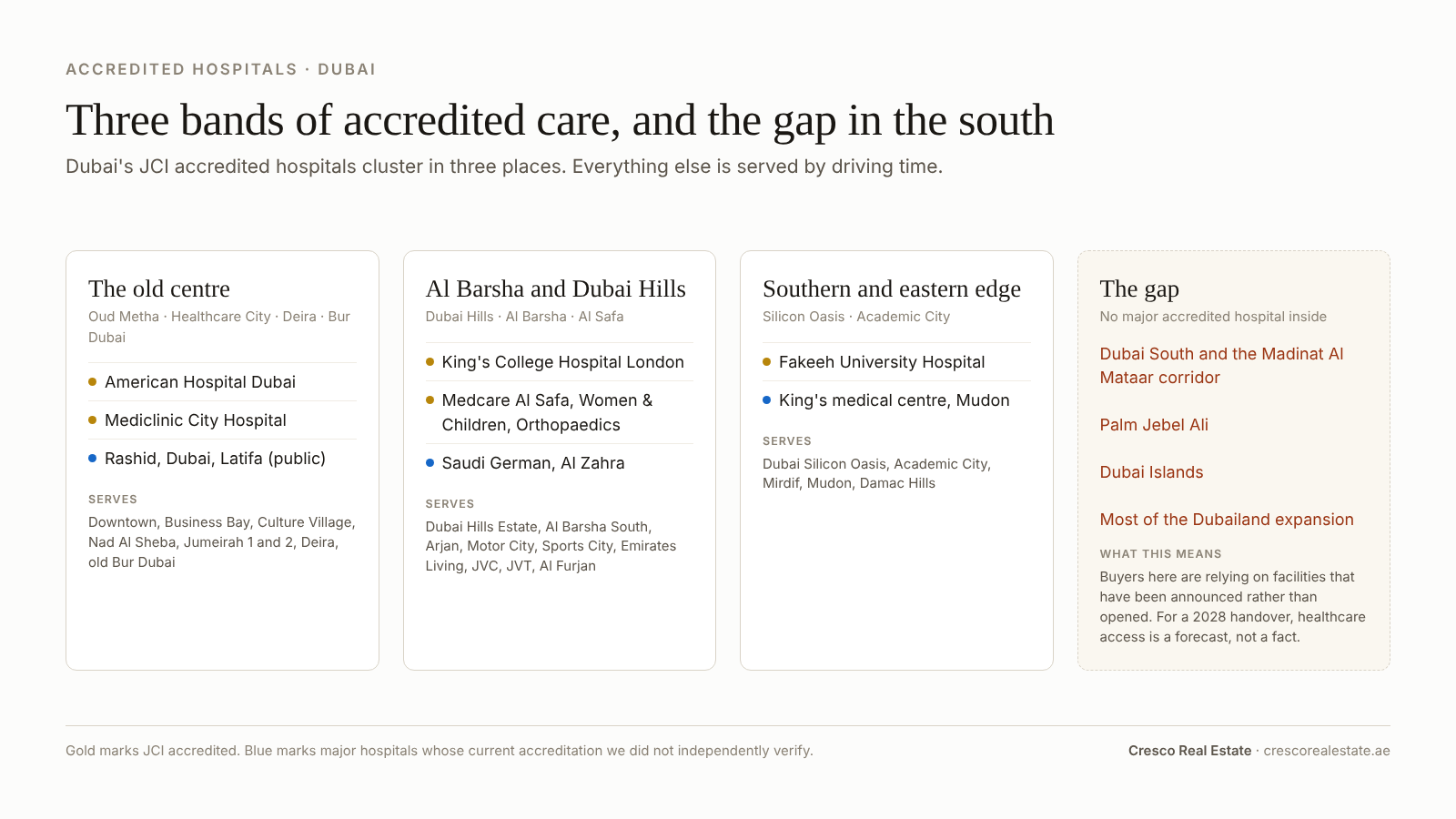
Dubai’s accredited hospitals cluster in three bands. Everything else is served by distance.
The old centre, Oud Metha, Healthcare City, Deira, Bur Dubai. The densest concentration in the city. American Hospital, Mediclinic City Hospital and the Dubai Health public hospitals all sit within a few minutes of each other. Communities drawing on it: Downtown, Business Bay, Culture Village, Nad Al Sheba, Jumeirah 1 and 2, Deira, and the older Bur Dubai stock.
The Al Barsha and Dubai Hills band. King’s College Hospital anchors Dubai Hills; Saudi German, Al Zahra and an American Hospital branch sit in Al Barsha; the Medcare hospitals are a short run up Al Wasl Road. This band covers Dubai Hills Estate, Al Barsha South, Arjan, Motor City, Sports City, Emirates Living, JVC, JVT and Al Furjan, which is most of the mid-market family demand in the city.
The southern and eastern edge. Fakeeh University Hospital serves Dubai Silicon Oasis, Academic City, Mirdif and the Mudon and Damac Hills communities, with a King’s medical centre in Mudon itself.
The gaps worth knowing about. Dubai South and the Madinat Al Mataar corridor, where a large share of 2026 studio and one-bedroom volume is being sold, has no major accredited hospital within it yet. Nor does Palm Jebel Ali, Dubai Islands, or most of the Dubailand expansion. Buyers in those areas are relying on a pipeline of facilities that has been announced rather than opened. If you are buying off-plan in the far south for handover in 2028, the honest position is that healthcare access there is a forecast, not a fact.
The same logic applies to schools, and we mapped those against sale prices community by community in our KHDA inspection ratings guide.
What to do with this before you buy
Four things, in order, and none of them takes long.
- Name the hospital you would use. Not the one with the best website, the one your family would be driven to at speed.
- Drive it once, in traffic, from the property you are considering. The map figure and the Thursday-morning figure are not the same number.
- Call that hospital’s billing desk and confirm your insurance tier is accepted, and at what co-pay.
- If you are buying off-plan, ask what is actually open near the handover date, not what is announced. Announced facilities slip at the same rate buildings do.
Healthcare access is one of the quieter things that sets resale value apart between two communities with similar prices per square foot. It rarely shows up in a brochure and it never shows up in a launch price.
Questions people ask
Which hospitals in Dubai have JCI accreditation?
American Hospital Dubai, Mediclinic City Hospital, King’s College Hospital London Dubai, the three Medcare hospitals in Al Safa and Fakeeh University Hospital all hold JCI accreditation on the published record. Dubai has more than forty hospitals and this list is not exhaustive.
Is a DHA licence the same as accreditation?
No. A Dubai Health Authority licence is the legal minimum every hospital and clinic must hold to operate. JCI accreditation is a voluntary external audit against international patient-safety standards, renewed every three years.
Is health insurance mandatory in Dubai?
Yes. Your employer must cover you. You cover your spouse, children, any parents on your sponsorship and your domestic staff. An employer who leaves a staff member uninsured faces a fine of AED 500 to AED 1,000 per month per person.
Will my insurance be accepted at any Dubai hospital?
No. The network is set by your policy tier, not by where you live. An Essential Benefits Plan, the minimum legal cover for anyone earning AED 4,000 a month or less, does not give access to the major private hospitals. Call the hospital’s billing desk and confirm before you rely on it.
Which Dubai communities have no major hospital nearby?
Dubai South and the Madinat Al Mataar corridor, Palm Jebel Ali, Dubai Islands and most of the Dubailand expansion have no major accredited hospital inside them. Facilities have been announced for several of these areas but announcements slip at the same rate buildings do.
Can anyone use a public hospital in Dubai?
Emergency care at a Dubai Health public hospital is available to anyone, resident or not. Dubai Health runs Rashid Hospital, Dubai Hospital, Latifa Hospital for women and children, and Hatta Hospital.