
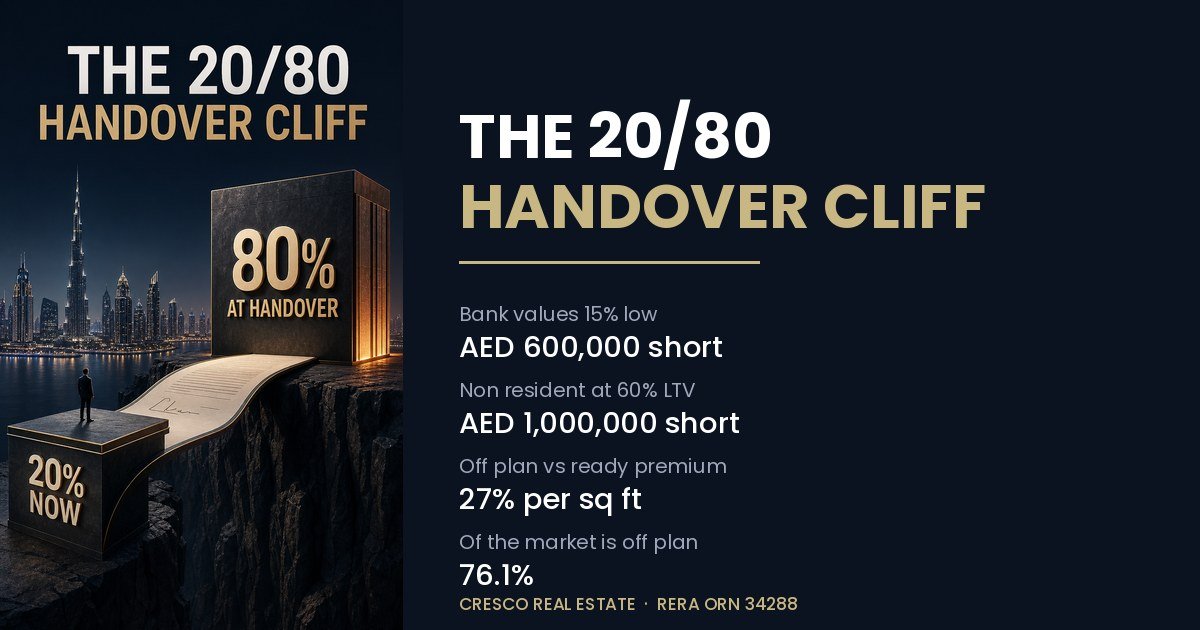
A 20/80 payment plan does not make a property cheaper. It moves the hard part of the purchase three years into the future, to a moment when the buyer has the least control over the outcome. We ran the numbers on the exact scenario, using the Central Bank lending caps and our own analysis of 18,587 registered Dubai Land Department sales.
What is being sold
Pay 20% during construction. Pay the remaining 80% at handover.
The pitch works because it answers the question the buyer is asking. Can I afford to start? Almost always yes.
It does not answer the question that decides whether the purchase survives. Can I fund the 80%, three years from now, at a valuation and an interest rate nobody in the room can predict today?
The stress test nobody runs before the buyer signs
Take a property sold at AED 5,000,000. The buyer pays AED 1,000,000 during construction. AED 4,000,000 falls due at handover.
At handover the buyer applies for a mortgage. The bank does two things. It instructs its own valuation, and it lends against the lower of the purchase price or that valuation, not against the price on the contract.
Under UAE Central Bank Circular 31/2013 as amended, an expatriate buying a first home worth up to AED 5,000,000 can borrow a maximum of 80% of the value of the property. Here is what that produces.
| Bank valuation | Value | Max loan at 80% | Due at handover | Cash shortfall |
|---|---|---|---|---|
| At purchase price | AED 5,000,000 | AED 4,000,000 | AED 4,000,000 | AED 0 |
| 10% below | AED 4,500,000 | AED 3,600,000 | AED 4,000,000 | AED 400,000 |
| 15% below | AED 4,250,000 | AED 3,400,000 | AED 4,000,000 | AED 600,000 |
| 20% below | AED 4,000,000 | AED 3,200,000 | AED 4,000,000 | AED 800,000 |
A 15% valuation gap turns into AED 600,000 of cash the buyer has to find, in addition to the AED 1,000,000 already paid and the AED 200,000 Dubai Land Department transfer fee.
Total cash across the deal: AED 1,800,000. The buyer was sold a plan that started with AED 1,000,000.
If the buyer is overseas, it is materially worse
Non resident buyers do not get 80%. Most lenders cap non residents at 60% to 65% loan to value, and many will not lend on off plan at all until it completes.
| Scenario | Loan available | Due at handover | Cash shortfall |
|---|---|---|---|
| Non resident, 65% LTV, valuation holds | AED 3,250,000 | AED 4,000,000 | AED 750,000 |
| Non resident, 60% LTV, valuation holds | AED 3,000,000 | AED 4,000,000 | AED 1,000,000 |
| Non resident, 60% LTV, valuation 15% below | AED 2,550,000 | AED 4,000,000 | AED 1,450,000 |
Read the middle row carefully. A non resident on a 60% loan to value faces a AED 1,000,000 shortfall even if the valuation comes in exactly at the purchase price. Nothing has to go wrong. The arithmetic does not work from the day the contract is signed.
Where the valuation gap actually comes from
This is the part that gets waved away, so here is our own measurement rather than an opinion.
We took 18,587 residential sales registered with the Dubai Land Department between 30 June and 18 August 2026 and compared off plan against ready for the same bedroom count in the same community, with a minimum of ten registered sales on each side. Sixty clean comparisons covering 6,295 sales.
Off plan registered at a median 27% above ready stock per square foot. 54 of the 60 comparisons went that way. 22 showed a premium above 40%.
That premium is not fraud. Part of it is the value of paying over time, part is that the building is new against ready stock that is often 15 to 20 years old. But a bank valuer at handover is not valuing the payment plan. They are valuing the apartment against comparable completed sales.
So when the pitch says a 10% to 15% valuation gap is unlikely, look at what you actually paid relative to the ready market in that specific community. If the answer is 27% or 40%, the gap is not a risk scenario. It is the starting position.
The market is heavily exposed to this
76.1% of every registered residential sale in that period was off plan. Of sales at AED 5,000,000 and above, 69% were off plan.
This is not a niche product being sold to a handful of speculators. It is how most of the Dubai market now transacts, which is precisely why the handover funding question deserves more scrutiny than it gets.
What happens if the buyer cannot fund it
Three options, all bad, in rough order of preference.
- Find the additional cash. Possible for a financially secure buyer. Not what they planned for.
- Sell before handover. This works when you are the only one doing it. If a tower completes and hundreds of buyers face the same shortfall in the same quarter, you are competing against the very people you bought alongside, and often against the developer still selling remaining stock at list price.
- Default. Under Law No. 13 of 2008 as amended, the amount a developer may retain on cancellation depends on the construction percentage completed. It can be a substantial share of what has been paid.
Meanwhile the transaction already recorded as a full price sale. The developer booked it. The agent was paid. The market reported another data point at a number that may never be tested by a real resale.
What every buyer should be shown before signing
None of this makes 20/80 wrong. It makes selling 20/80 without a handover stress test wrong. A buyer should see all seven of these in writing before they pay a reservation deposit.
- Comparable ready property prices in the same community, per square foot, from registered transactions
- Realistic mortgage eligibility, including whether they qualify as resident or non resident
- The cash shortfall if the bank values 10% and 15% below the purchase price
- Resale and assignment restrictions in the contract, including any construction percentage threshold before assignment is permitted
- Cancellation and default consequences and what the developer may retain
- All commissions and developer incentives in the transaction
- The service charge estimate for the building, because it starts the day of handover
The question we ask clients before a 20/80. Forget the 20%. If handover were tomorrow and the bank valued the unit 15% low, could you write the cheque? If the answer is no, the plan is not affordability. It is a deferred problem with your name on it.
When 20/80 genuinely works
It is a good structure for a buyer who could have paid cash anyway and prefers to keep capital working elsewhere. It is a good structure when the price is at or below the ready market in that community, which our data shows happens in roughly one comparison in ten. It is a good structure in a community with no ready stock, where there is no comparable to be valued against and the buyer knows they are taking that risk deliberately.
It is a poor structure for a buyer whose ability to complete depends on a mortgage they have not been pre assessed for, on a valuation nobody has modelled, in a community where off plan is already trading well above the resale market.
Frequently asked questions
What is a 20/80 payment plan in Dubai?
A developer payment structure where the buyer pays 20% of the purchase price during construction and the remaining 80% at handover. The appeal is the low entry cost. The risk is that the 80% falls due at a future date, usually funded by a mortgage that has not yet been approved and against a valuation that has not yet been done.
What is the risk of a 20/80 payment plan?
The bank lends against its own valuation, not the contract price. On a AED 5,000,000 purchase with an 80% expat loan to value, a valuation 15% below the purchase price leaves the buyer AED 600,000 short in cash at handover. A non resident capped at 60% loan to value faces a AED 1,000,000 shortfall even if the valuation holds.
What is the maximum mortgage LTV in the UAE?
Under UAE Central Bank Circular 31/2013 as amended, a first home owner occupier may borrow up to 85% if a UAE national and 80% if an expatriate for property up to AED 5,000,000, falling to 75% and 70% respectively above AED 5,000,000. Non resident buyers are typically offered less, commonly 60% to 65%.
Does the bank value the property at the price I paid?
Not necessarily. The bank instructs its own valuation and lends against the lower of the purchase price or that valuation. If you paid above the comparable market, the difference becomes cash you must find yourself.
How much more does off plan cost than ready property in Dubai?
A median of 27% more per square foot across 60 like for like comparisons of registered Dubai Land Department sales between 30 June and 18 August 2026, matched on community and bedroom count with at least ten sales on each side.
Can I sell an off plan unit before handover?
Usually only after a minimum construction percentage set by the developer and the Dubai Land Department, and subject to a developer NOC and fees. Check the assignment clause before signing, not when you need to use it.
What happens if I cannot pay the 80% at handover?
You must fund the shortfall in cash, sell or assign before completion, or default. Under Law No. 13 of 2008 as amended, the amount a developer may retain on cancellation depends on the percentage of construction completed and can be a substantial share of what you have paid.
Sources. Loan to value caps per UAE Central Bank Rulebook, amendments to Circular No. 31/2013 on Regulations regarding Mortgage Loans. Off plan premium, off plan market share and all transaction counts calculated by Cresco Real Estate LLC from the Dubai Land Department open data portal, registered transactions 30 June to 18 August 2026, 18,587 qualifying residential unit sales after cleaning. Mortgages and gift transfers excluded. Medians, not averages. Worked examples are illustrative and assume the bank lends against the lower of price or valuation, which is standard practice but varies by lender.
Cresco Real Estate LLC, RERA ORN 34288. This article is market analysis and not personal investment, mortgage or legal advice. Lending criteria and developer terms vary and change.
The wider price picture behind this stress test, including why off plan costs more per square foot than ready, is in Dubai property prices per square foot, August 2026.