
We are a Dubai brokerage. We sell off-plan property. What follows explains why brokerages like ours have a financial reason to steer you toward it, and you should read everything we say with that in mind.
We are publishing it anyway, because the question gets asked in every second conversation and the usual answer, a long explanation of why off-plan is wonderful, is not an answer.
The short version: on a typical off-plan sale the developer pays the broker, and pays more than a seller does on a resale. That is a real incentive, it is structural rather than dishonest, and once you can see it you can work around it.
How a broker gets paid, in both cases
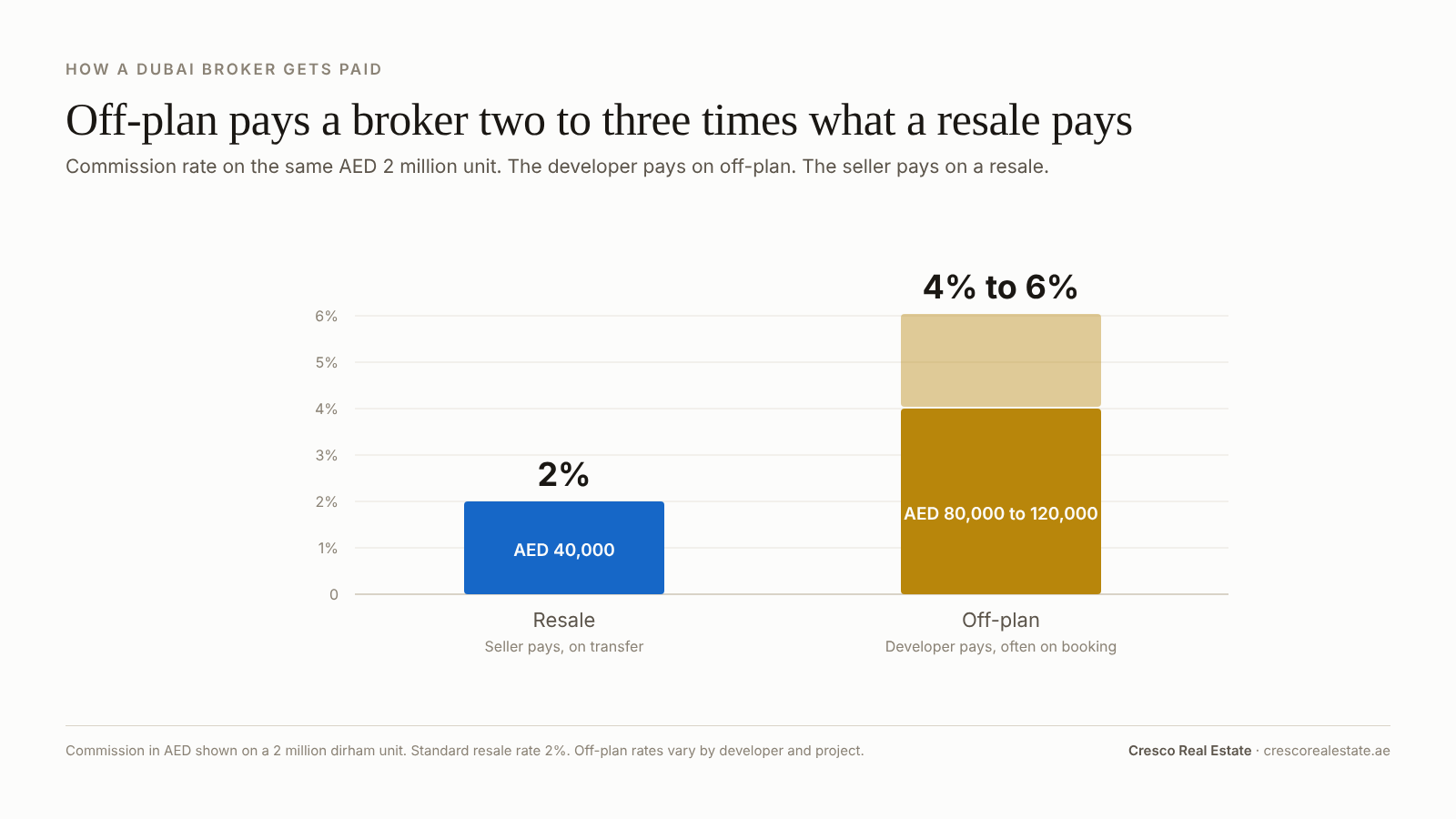
| Who pays | Typical commission | Paid when | |
|---|---|---|---|
| Off-plan, direct from developer | The developer | Commonly 4% to 6%, sometimes higher on slow-moving stock or launch incentives | Usually on booking or at a set payment milestone |
| Resale, secondary market | The seller | Standard 2% | On transfer at the Land Department |
Two things follow from that table and neither is a secret.
The first is the rate. An off-plan sale can pay two to three times what a resale of the same value pays. On an AED 2 million unit that is roughly AED 100,000 against roughly AED 40,000.
The second is the timing, and it matters more than people think. A resale commission arrives after a transfer that may take two months and may collapse. An off-plan commission can arrive on booking. Faster money at a higher rate with less that can go wrong in between.
There is a third layer on top: developers run broker incentives, bonus tiers, raffles, trips, extra points on specific towers that are not selling. A brokerage with a volume target on a particular project has a reason to put that project in front of you that has nothing to do with you.
What that does to the advice you hear
Almost nobody in this business lies to clients. The incentive does not work by producing lies. It works by shaping which true things get said.
It shows up as emphasis. Off-plan genuinely does offer payment plans, genuinely has lower entry prices, genuinely has delivered capital growth for a lot of people in the last five years. All true. An agent paid three times more to sell it will reach for those truths first, more often, and with more conviction than the agent’s own view of your situation might warrant.
It shows up as omission. Nobody is obliged to volunteer that you cannot resell until you have paid 40%, that the handover window has a twelve-month grace period, or that 203 of the 324 projects registered in Dubai this year have not broken ground. These are not asked about, so they are not raised.
It shows up in what gets shown. You describe what you want; you are sent three off-plan options. Not because the resale market had nothing, Dubai registered 11,988 resales in Q3 alone, but because the off-plan inventory is what the brokerage has a commercial relationship with.
And it shows up in urgency. Launch-day pricing, limited release, the price rises next phase. Some of that is real. All of it serves the party whose commission depends on a booking today.
Where off-plan is genuinely the better buy
An incentive to recommend something does not make the thing bad. Off-plan is the right purchase for a real set of buyers, and the case deserves stating as fairly as the criticism.
When you have income but not capital. A payment plan spreads the cost across construction. A buyer who can commit AED 15,000 a month but cannot write AED 400,000 today can own through off-plan and cannot through ready. That is not a trick, it is the product doing exactly what it exists to do.
When your horizon is long and genuine. If you are buying to hold for a decade, the handover delay that ruins a flipper’s return is noise. Off-plan entry prices sit below equivalent ready stock, and over ten years that discount is worth more than the wait costs.
When the escrow protection matters to you. Off-plan payments in Dubai are held in project escrow accounts under Law No. 8 of 2007. Your money is not the developer’s working capital. This is a materially stronger buyer protection than most markets offer.
When the specific product does not exist ready. New communities, new typologies, branded residences. If what you want has never been built, off-plan is the only way to own it.
When you want to live in it. Much of the criticism of off-plan is about exit liquidity. An end user who is going to move in and stay has a much smaller exposure to that than an investor does.
Where it is not
When you need to be able to get out. You cannot assign most off-plan units until you have paid 30% to 40%, and even then the developer controls approval and charges for the NOC. A buyer on a light early payment plan has no exit until handover. That mechanism is set out in the off-plan locked exit.
When the plan is doing the persuading. A 20/80 looks like low risk and behaves like high risk: you arrive at handover owing 80% of a price set years earlier, into whatever market exists then. The 20/80 payment plan risk covers it.
When you are buying into a wave. Roughly 146,400 units are scheduled for handover in 2027 and 120,100 in 2028. Even at historic delivery rates well under half, that is a great deal of simultaneous supply, and every investor in your tower hits the resale market on the same day you do. Dubai’s next property problem runs the numbers.
When the developer has no record. Of the 324 projects registered in Dubai in 2026, 203 had not broken ground when we checked. A first-time developer promising a 2029 handover is selling a plan, not a building. We set out how to check this in how to check a developer’s delivery record.
When the yield needs to start now. Off-plan pays nothing until handover. If you need the rent, you need a ready unit.
And a timing point that is specific to this month. August 2026 recorded the first year-on-year decline in average Dubai home prices since February 2021. In a flat or falling market the off-plan premium, the gap between launch pricing and comparable ready stock, stops being underwritten by growth. That changes the calculation for anyone buying off-plan primarily for appreciation. The month’s full numbers are in the September 2026 market report.
Four questions that expose the incentive
Ask these of any broker in Dubai. Ask them of us.
“What are you paid on this, and who pays you?” A direct question with a direct answer. Hesitation, or a reply about being paid by the developer so it costs you nothing, is the answer. It does cost you something, it is inside the price.
“Show me the comparable ready units.” If the honest answer is that ready stock does not suit your situation, a competent broker can say so in one sentence and show you the comparison anyway. If no comparison appears, you are being shown inventory rather than advised.
“What would make you tell me not to buy this?” A broker who has never advised a client against a unit is not advising anyone.
“How many units in this project are investor-held?” The sales team knows. It tells you who you will be competing with on the day the building hands over.
None of these questions is hostile. All four are normal in markets where advice is paid for separately from transactions, and Dubai is not one of those markets yet.
How we handle it
The incentive described above applies to us. We cannot remove it, it is how the Dubai market pays brokers, so we manage it instead. These are the commitments we hold ourselves to, and you should hold us to them too.
- We tell you what we are paid on a unit when you ask, and we do not treat the question as rude.
- We show the ready comparable alongside any off-plan recommendation, even when the comparison does not help us.
- We will tell you when the answer is not to buy, including when the answer is not to buy from us.
- We publish the risks of the product we sell. The locked exit, the 20/80 problem and the handover wave are all on this site, written by us, about our own market.
That last one is the test worth applying to any brokerage. Read what they publish. If every article is a reason to buy, you are reading marketing. If some of it would cost them a sale, you are reading something closer to advice.
Questions people ask
How much commission does a Dubai broker make on off-plan?
Commonly 4% to 6%, paid by the developer rather than the buyer, and sometimes higher on slow-moving stock or during launch incentives. On an AED 2 million unit that is roughly AED 80,000 to AED 120,000.
Who pays the broker in a Dubai property sale?
On off-plan the developer pays, usually on booking or at a set payment milestone. On a resale the seller pays the standard 2%, on transfer at the Land Department.
Does off-plan cost the buyer more because of commission?
The commission is not billed to you separately on off-plan, but it is inside the price the developer sets. Being told it costs you nothing is not accurate.
Why do Dubai agents only show me off-plan?
Usually because off-plan pays two to three times what a resale pays, and pays sooner. Dubai registered 11,988 resales in Q3 2026, so the secondary market is not empty. Ask directly for the comparable ready units.
What should I ask a Dubai broker before buying?
Four questions. What are you paid on this and who pays you. Show me the comparable ready units. What would make you tell me not to buy this. How many units in this project are investor-held.
Is off-plan a bad investment in Dubai?
Not inherently. It suits buyers with income but not capital, a genuine long horizon, or who want a product that does not exist ready. It suits you less if you need to exit before handover, if you need rent now, if the developer has no delivery record, or if you are buying primarily for appreciation in a market whose broad price index has just turned negative.