
Every one of the five things below can be checked before you sign. None of them requires a lawyer, a contact inside the developer, or information you are not entitled to. Most take under an hour.
Almost nobody checks them.
The reason is not laziness. A Dubai purchase moves fast by design, the launch, the unit release, the reservation form, the ten percent. By the time a buyer thinks to ask about handover penalties, the deposit is already paid and hard to recover. What follows is ordered by how much money each check can save you, largest first.
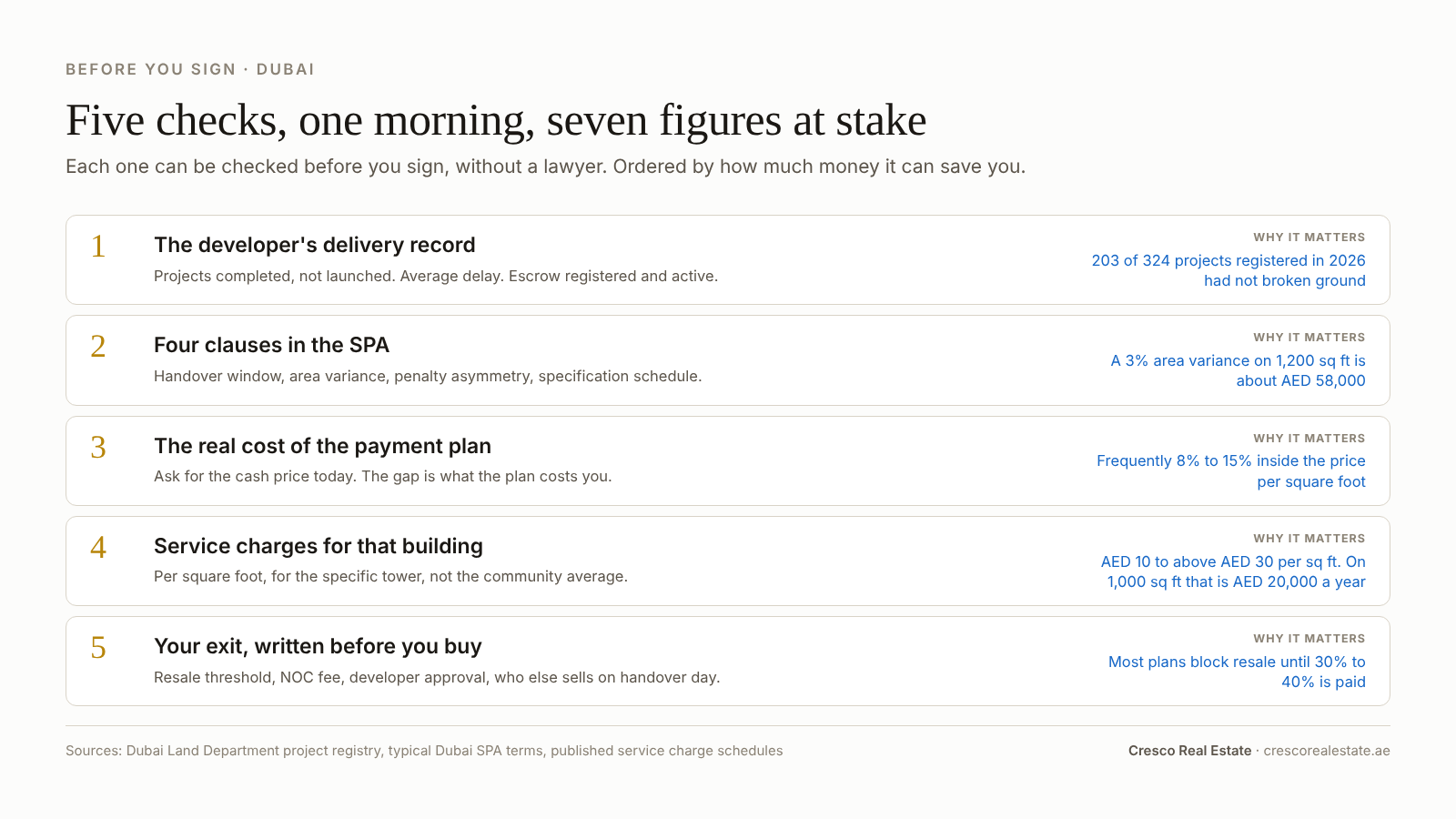
One. The developer has a delivery record, and it is public
Every developer selling off-plan in Dubai has a history of projects promised and projects handed over. The gap between those two numbers is the most predictive thing you can know about your purchase, and it is a matter of public record through the Dubai Land Department and its project registry.
What you are looking for is specific:
- How many projects has this developer completed, as opposed to launched?
- What was the average delay between the original handover date and the actual one?
- Is the escrow account for this specific project registered and active?
- Has the developer ever cancelled a registered project?
A developer on their first tower is not disqualified by that. A developer on their first tower who is promising a 2028 handover with a 20/80 payment plan is making a promise their track record cannot support, and you should price that risk rather than ignore it.
We wrote the full method for pulling this yourself in how to check a Dubai developer’s delivery record.
The wider context matters too: of the 324 projects registered in Dubai in 2026, 203 had not broken ground when we last checked. Registration is not construction.
Two. The SPA is where the money actually moves
The Sale and Purchase Agreement is the only document in the transaction that binds anyone. The brochure does not. The sales consultant’s assurances do not. Read four clauses before you read anything else.
The handover window. Not the handover date, the window. Most SPAs give the developer a grace period beyond the stated date, often twelve months, before any remedy applies to you. A unit sold as “Q2 2028” may contractually mean mid-2029 without the developer being in breach.
The area variance clause. Your unit will be measured on completion, and the SPA states the tolerance. A typical clause permits a variance of a few percent with no adjustment, and requires you to pay for any excess above it. On a 1,200 square foot apartment at AED 1,600 a foot, a 3% unfavourable variance you cannot contest is roughly AED 58,000.
Penalty asymmetry. Look at what you owe for a late payment, then look at what the developer owes for a late handover. In most Dubai SPAs these are not comparable. Your late payment carries interest and, past a threshold, forfeiture. Their late delivery frequently carries nothing at all.
The specification schedule. “Or equivalent” and “subject to availability” are the two phrases that turn a marble kitchen into a different kitchen. If a finish sold you the unit, find it named in the schedule.
We took this apart clause by clause in the SPA clauses that cost buyers money.
Three. The payment plan is not the price
A 20/80 plan and a 60/40 plan on the same unit at the same headline price are not the same purchase. The plan decides how much of your capital is at risk before you own anything, and what your options are if the market moves.
Post-handover plans are sold as a convenience and priced as a product. A developer offering three years of post-handover instalments is lending you money, and the cost of that lending is inside the price per square foot you agreed. Compare the same unit against a ready equivalent in the secondary market to see what you paid for the plan. Frequently it is 8% to 15%.
The second issue is what a light early plan does to your position. On a 20/80, you reach handover having paid 20%, which sounds protective until the market softens and you need to exit. A buyer who has paid 20% of a unit now worth less than the contract price is holding a liability that needs the remaining 80% to be resolved. We set this out in the 20/80 payment plan risk.
The question to ask the sales consultant is simple and they will not expect it: what is the cash price of this unit, paid in full today? The gap between that and the plan price is the real cost of the plan.
Four. Service charges decide your actual yield
The yield quoted to you is gross. The yield you receive is net, and the difference is mostly service charges.
Service charges in Dubai are levied per square foot per year and vary enormously, broadly from around AED 10 in simpler communities to above AED 30 in towers with extensive amenities. On a 1,000 square foot apartment that is a swing of AED 20,000 a year, every year, against a rent that may be AED 90,000.
Run it properly before you buy:
- Get the current service charge per square foot for the specific building, not the community average.
- Multiply by your unit’s area. That is your annual charge.
- Subtract it, plus management fees and a vacancy allowance, from your expected annual rent.
- Divide by the all-in purchase price including the 4% transfer fee and agency commission.
That last number is your yield. It is usually one and a half to two percentage points below the figure in the brochure.
Two warnings. Off-plan service charges are estimates until the building is occupied and the owners association sets them, and they tend to settle higher than projected. And amenity-heavy towers carry their amenities in the charge forever, long after the rooftop pool has stopped being a reason anyone rents there.
Five. Your exit is decided before you buy, not when you sell
Most buyers think about selling as a future problem. In Dubai it is a present one, because the terms of your exit are written into the contract you are about to sign.
The resale threshold. Most developers prohibit assignment of an off-plan unit until you have paid a set percentage, commonly 30% to 40%. Until you cross it, you cannot sell at any price. If your plan only reaches 20% by handover, you have no exit before handover at all.
The NOC fee. The developer charges for the no-objection certificate that lets a transfer complete. It runs from a few thousand dirhams to over AED 15,000 depending on the developer, and it is theirs to set.
The administrative gate. Approval is not automatic, and the timeline is the developer’s. A sale that needs to close in three weeks can fail on this alone.
The market you will be selling into. This is the one nobody models. If you buy in a tower of 600 units with a single handover date, then on that date you are competing with every other investor in the building who also wants out. Check how many units in your project are held by investors rather than end users. The sales consultant knows, and will usually tell you if asked directly.
The whole mechanism, and what it does to people who did not read it, is in the off-plan locked exit.
Before you sign anything
Have these in hand. If a seller or agent cannot produce them, that is itself the answer.
- The developer’s completed-project count and average handover delay
- Confirmation the project’s escrow account is registered and active
- The full SPA, read: handover window, area variance, penalties, specification schedule
- The cash price of the unit, for comparison against the plan price
- Current service charge per square foot for that specific building
- The resale threshold percentage and the NOC fee
- Your net yield, calculated on the all-in purchase price
Seven items. A morning’s work against a purchase that will run into seven figures.
If you want these checked on a specific unit before you commit, that is work we do as a matter of course, including on units we are not selling you.
Questions people ask
What should I check before buying off-plan in Dubai?
Five things, in this order. The developer’s completed-project count and average delay. Four clauses in the SPA: handover window, area variance, penalty asymmetry and specification schedule. The cash price of the unit against the plan price. The service charge per square foot for that specific building. And your exit terms: resale threshold, NOC fee and developer approval.
Can I sell an off-plan property in Dubai before handover?
Only once you have paid the developer’s resale threshold, commonly 30% to 40% of the price. Below that you cannot assign the unit at any price. The developer also charges an NOC fee, from a few thousand dirhams to over AED 15,000, and controls the approval timeline.
How much are service charges in Dubai?
Broadly from around AED 10 per square foot per year in simpler communities to above AED 30 in towers with extensive amenities. On a 1,000 square foot apartment that is a difference of about AED 20,000 a year against a rent that may be AED 90,000.
What is an area variance clause in a Dubai SPA?
It sets how much the finished unit may differ in size from the one you bought. A typical clause allows a few percent with no price adjustment and requires you to pay for any excess. On a 1,200 square foot apartment at AED 1,600 a foot, an uncontestable 3% variance is roughly AED 58,000.
Does a Dubai payment plan cost extra?
Usually yes, and the cost is inside the price rather than shown separately. Comparing the same unit against a ready equivalent in the secondary market frequently reveals a premium of 8% to 15%. Ask for the cash price paid in full today. The gap is what the plan costs.
Is the handover date in a Dubai SPA binding?
Not on its own. Most SPAs give the developer a grace period beyond the stated date, often twelve months, before any remedy applies to the buyer. A unit sold as Q2 2028 may contractually mean mid-2029 without the developer being in breach.